

 简体中文
简体中文 Русский язык
 بالعربية
 Türkçe
 Português
 ภาษาไทย
 Deutsch
 한어
한어 Français
Iran: How "Aerial Scooters" Achieve Low-Cost Chip Solutions
# Iran’s UAV Chip Strategy: Civilian-to-Military Conversion, Reverse Engineering, and Gradual Indigenous Development
Iran’s UAV chip ecosystem centers on **civilian off-the-shelf component militarization, reverse engineering, international collaboration, and incremental indigenous R&D**. Aligned with the goals of **low cost, high reliability, and mass production**, it has built a tiered chip roadmap to suit loitering munitions, strike-reconnaissance UAVs, electronic warfare (EW) UAVs, and other platforms.
## I. Core Approach and Architecture: A “Combination Punch” for Low-Cost Chips
### 1. Demand Tiering and Targeted Chip Downscaling
| UAV Type | Core Chip Requirements | Low-Cost Solutions | Representative Models/Components |
|----------|------------------------|--------------------|-----------------------------------|
| Loitering Munition (e.g., Shahed-136) | Basic flight control, navigation, power control | Civilian MCU/DSP + general-purpose RF + navigation modules | STM32G071, TI TMS320F28335, ADI AD9361 |
| Strike-Reconnaissance (e.g., Mohajer-6) | Imaging, data link, basic AI | Civilian CMOS + mid-low-end FPGA + integrated navigation | OV5640, domestic 100k-logic-cell FPGA |
| EW UAV | Signal processing, jamming algorithms | Imported mid-range FPGA + domestic RF MMIC | Xilinx Virtex-7 XQ, Iranian domestic X-band MMIC |
### 2. Three Core Strategies for a Low-Cost Supply Chain
- **Civilian-to-military conversion**: Civilian chips (STM32, TI DSP) are epoxy-encapsulated for shock resistance, with simplified circuits and shortened lifespans optimized for “single-use” missions, cutting costs by over 70%.
- **Gray supply chains + diversified procurement**: Civilian chips are sourced via transit countries such as Turkey and the UAE. Navigation modules support BeiDou/GPS/GLONASS; full migration to BeiDou with Russian Kometa-M anti-jamming units began in 2025, achieving meter-level positioning accuracy.
- **Reverse engineering + local cloning**: Iran Electronics Industries (IEI) reverse-engineered firmware for chips like the STM32G071 and replicated them at domestic fabs. Sarmad reverse-engineered servo drive ICs for the Mohajer-6.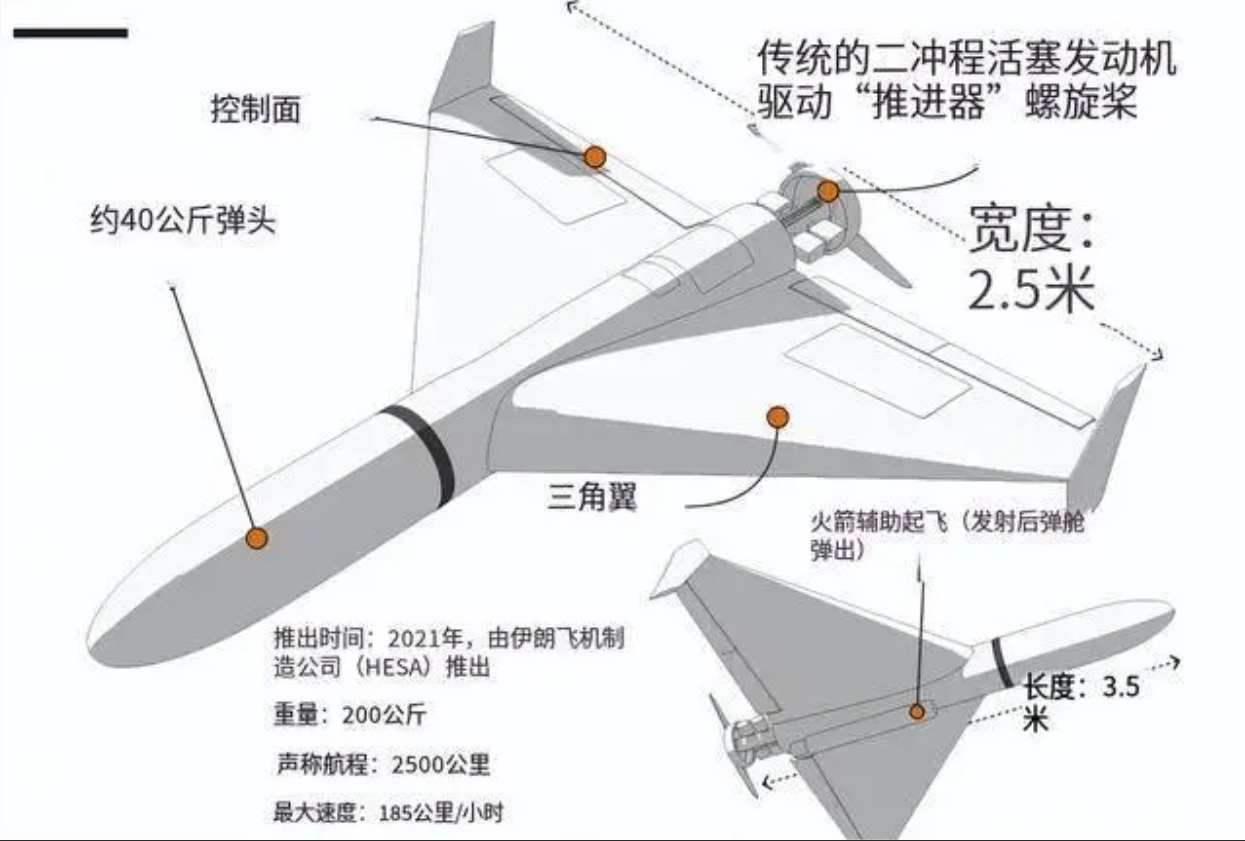 ## II. Module-by-Module Implementation: Low-Cost Realization from Flight Control to Navigation
### 1. Flight Control and Computing: FPGA–MCU Co-Design for Cost Reduction
- **Loitering munitions**: The STM32G071 (~$10) handles attitude calculation and servo control at 72 MHz, replacing high-end military-grade MCUs.
- **Strike-reconnaissance/EW**: Domestic mid-low-end FPGAs (100k logic cells) process inertial navigation and radar signals at just 1/5 the cost of premium imported FPGAs, suitable for low-compute tasks.
- **Computing optimization**: Overclocked civilian chips and streamlined algorithms meet basic AI needs (e.g., target detection) without high-end NPUs.
### 2. Navigation and Positioning: Multi-System Fusion for Anti-Jamming
- **Primary solution**: UniStrong MD Phantom P34 (BeiDou/GLONASS compatible) + Kometa-M anti-jamming unit, ensuring stable operation when GPS is denied.
- **Low-cost backup**: Civilian GPS module + inertial measurement unit (IMU) fusion, costing under $50 for low-intensity scenarios.
### 3. RF and Communications: General-Purpose Chips + Simplified Protocols
- Civilian RF chips (e.g., ADI AD9361) enable multi-band data links. Simplified communication protocols and reduced data rates balance anti-jamming performance and cost.
- Co-developed microwave MMICs with Russia; domestic production reduced RF module costs by 30%.
### 4. Power and Drive: Automotive/Industrial-Grade Chips Downscaled
- Automotive BCD-process power management ICs (including domestic alternatives) withstand wide temperatures and vibration, with stable supply and lower costs than military-grade parts.
- Civilian brushless motor controllers with firmware optimization for UAV powertrains; unit prices below $20 at scale.
## III. Indigenous Capacity Building: From Cloning to Incremental Self-Reliance
### 1. Key Entities and Production Layout
- **Iran Electronics Industries (IEI)**: Leads chip reverse engineering and cloning. Its Shiraz plant manufactures transistors, integrated circuits, and multilayer PCBs for core UAV electronics.
- **Sairan, ECI, and affiliates**: Focus on microelectronics, mass-producing hybrid circuits and low-end FPGAs to meet basic UAV needs.
### 2. Technology Roadmap: Three Stages to Self-Sufficiency
1. **Short term (1–2 years)**: Scale reverse engineering of civilian chips to achieve 100% domestic replacement for core components (STM32G071, TI DSP), reducing import dependency.
2. **Medium term (3–5 years)**: Co-develop dedicated UAV chips with China and Russia using 40 nm/28 nm nodes, integrating flight control, navigation, and RF functions for under $50.
3. **Long term (5–10 years)**: Master mid-to-high-end FPGA and RF MMIC technologies, establish an independent semiconductor line to support EW and high-end strike-reconnaissance UAVs.
## IV. Mass Production and Cost Control: Keys to Scaled Manufacturing
1. **Standardized design**: Unified chip interfaces enable modular reuse of components (STM32G071, AD9361), lowering R&D and procurement costs.
2. **Distributed manufacturing**: Assembly sites across Iran mitigate single-point failure risks; daily capacity exceeds 400 units.
3. **Swarm-tactics optimized**: Low-cost chips and simple structures bring Shahed-136 unit costs down to ~$20,000, delivering overwhelming cost-effectiveness.
## V. Challenges and Mitigation Strategies
| Challenge | Countermeasures |
|-----------|-----------------|
| Restricted access to high-end chips | Deepen tech cooperation with China and Russia for FPGA/RF tech; focus on mid-low-end segments to avoid over-engineering |
| Backward domestic processes (≥40 nm) | Prioritize specialty processes (BCD, SOI) for power and RF ICs instead of chasing leading-edge nodes |
| Complex electronic jamming environments | Dual BeiDou–GLONASS navigation; real-time FPGA jamming processing for improved resilience |
## Conclusion
Iran’s low-cost UAV chip strategy embodies asymmetric thinking: abandoning obsession with premium performance to prioritize essential functions. Through civilian component modification, reverse engineering, international collaboration, and gradual indigenous development, it has built a **low-cost, reliable, mass-producible** supply chain. This model not only satisfies operational requirements but also offers a reference for semiconductor development under sanctions.
## II. Module-by-Module Implementation: Low-Cost Realization from Flight Control to Navigation
### 1. Flight Control and Computing: FPGA–MCU Co-Design for Cost Reduction
- **Loitering munitions**: The STM32G071 (~$10) handles attitude calculation and servo control at 72 MHz, replacing high-end military-grade MCUs.
- **Strike-reconnaissance/EW**: Domestic mid-low-end FPGAs (100k logic cells) process inertial navigation and radar signals at just 1/5 the cost of premium imported FPGAs, suitable for low-compute tasks.
- **Computing optimization**: Overclocked civilian chips and streamlined algorithms meet basic AI needs (e.g., target detection) without high-end NPUs.
### 2. Navigation and Positioning: Multi-System Fusion for Anti-Jamming
- **Primary solution**: UniStrong MD Phantom P34 (BeiDou/GLONASS compatible) + Kometa-M anti-jamming unit, ensuring stable operation when GPS is denied.
- **Low-cost backup**: Civilian GPS module + inertial measurement unit (IMU) fusion, costing under $50 for low-intensity scenarios.
### 3. RF and Communications: General-Purpose Chips + Simplified Protocols
- Civilian RF chips (e.g., ADI AD9361) enable multi-band data links. Simplified communication protocols and reduced data rates balance anti-jamming performance and cost.
- Co-developed microwave MMICs with Russia; domestic production reduced RF module costs by 30%.
### 4. Power and Drive: Automotive/Industrial-Grade Chips Downscaled
- Automotive BCD-process power management ICs (including domestic alternatives) withstand wide temperatures and vibration, with stable supply and lower costs than military-grade parts.
- Civilian brushless motor controllers with firmware optimization for UAV powertrains; unit prices below $20 at scale.
## III. Indigenous Capacity Building: From Cloning to Incremental Self-Reliance
### 1. Key Entities and Production Layout
- **Iran Electronics Industries (IEI)**: Leads chip reverse engineering and cloning. Its Shiraz plant manufactures transistors, integrated circuits, and multilayer PCBs for core UAV electronics.
- **Sairan, ECI, and affiliates**: Focus on microelectronics, mass-producing hybrid circuits and low-end FPGAs to meet basic UAV needs.
### 2. Technology Roadmap: Three Stages to Self-Sufficiency
1. **Short term (1–2 years)**: Scale reverse engineering of civilian chips to achieve 100% domestic replacement for core components (STM32G071, TI DSP), reducing import dependency.
2. **Medium term (3–5 years)**: Co-develop dedicated UAV chips with China and Russia using 40 nm/28 nm nodes, integrating flight control, navigation, and RF functions for under $50.
3. **Long term (5–10 years)**: Master mid-to-high-end FPGA and RF MMIC technologies, establish an independent semiconductor line to support EW and high-end strike-reconnaissance UAVs.
## IV. Mass Production and Cost Control: Keys to Scaled Manufacturing
1. **Standardized design**: Unified chip interfaces enable modular reuse of components (STM32G071, AD9361), lowering R&D and procurement costs.
2. **Distributed manufacturing**: Assembly sites across Iran mitigate single-point failure risks; daily capacity exceeds 400 units.
3. **Swarm-tactics optimized**: Low-cost chips and simple structures bring Shahed-136 unit costs down to ~$20,000, delivering overwhelming cost-effectiveness.
## V. Challenges and Mitigation Strategies
| Challenge | Countermeasures |
|-----------|-----------------|
| Restricted access to high-end chips | Deepen tech cooperation with China and Russia for FPGA/RF tech; focus on mid-low-end segments to avoid over-engineering |
| Backward domestic processes (≥40 nm) | Prioritize specialty processes (BCD, SOI) for power and RF ICs instead of chasing leading-edge nodes |
| Complex electronic jamming environments | Dual BeiDou–GLONASS navigation; real-time FPGA jamming processing for improved resilience |
## Conclusion
Iran’s low-cost UAV chip strategy embodies asymmetric thinking: abandoning obsession with premium performance to prioritize essential functions. Through civilian component modification, reverse engineering, international collaboration, and gradual indigenous development, it has built a **low-cost, reliable, mass-producible** supply chain. This model not only satisfies operational requirements but also offers a reference for semiconductor development under sanctions.